

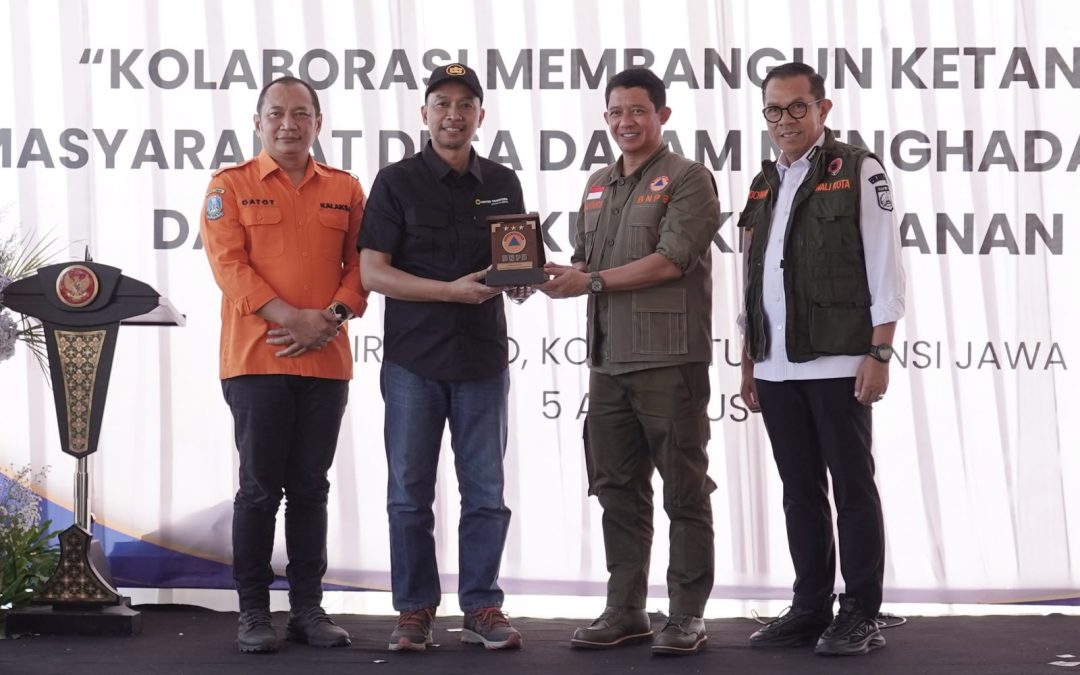
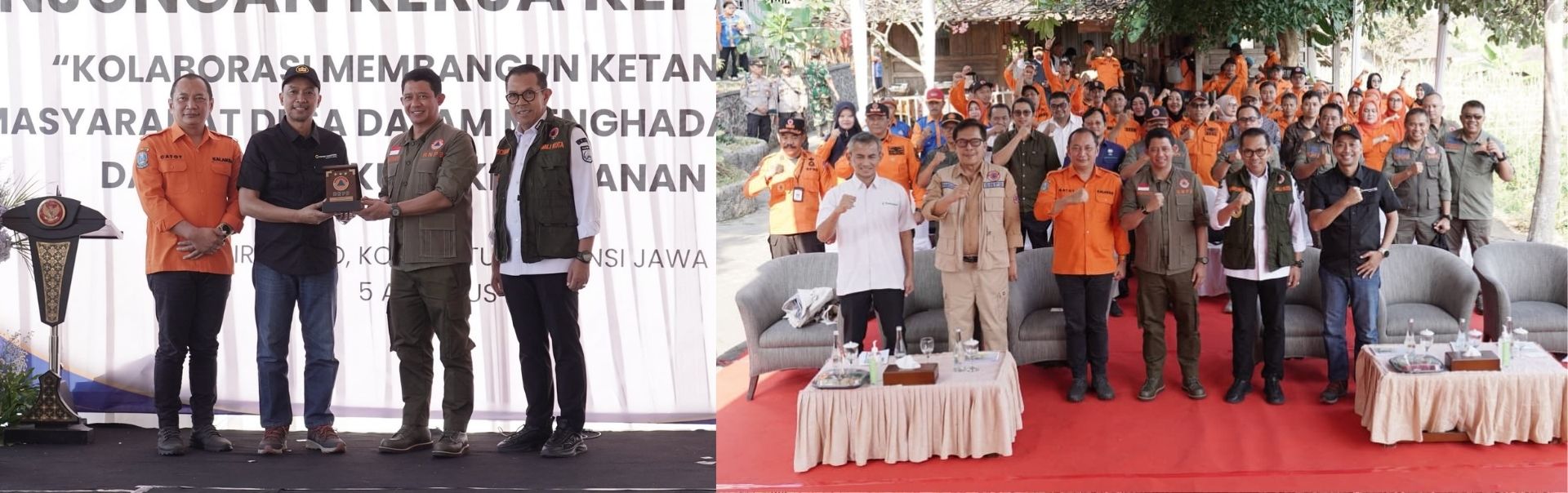
The symbolic handover from the Head of BNPB, Suharyanto, to United Tractors (UT), represented by Dianwahyu Sri Purnomo, during the inauguration of the Giripurno Village TPS3R (left photo). A group photo session featuring government officials, UT representatives, and all invited guests (right photo).
Batu, August 10, 2026 – PT United Tractors Tbk (UT), together with the National Disaster Management Agency (BNPB) and the Batu City Government, reaffirmed its commitment to creating a sustainable environment and strengthening community resilience through the inauguration of a Reduce, Reuse, Recycle Waste Management Facility (TPS3R) and a Disaster Resilient Village (Desa Tangguh Bencana) in Giripurno Village, Batu City, East Java. This collaboration integrates circular economy-based waste management with efforts to improve disaster preparedness as part of climate change mitigation measures, while simultaneously encouraging the community to independently and sustainably build a resilient environment.
The operational inauguration of the Giripurno Village TPS3R was marked by the signing of a plaque and ribbon-cutting by the Head of BNPB, Suharyanto; the Mayor of Batu, Haji Nurochman; and the Head of Corporate Communications and Sustainability Division of UT, Dianwahyu Sri Purnomo. With a processing capacity of up to 800 kilograms of waste per day, this facility applies the concept of a circular economy by processing organic waste into maggot feed. It is equipped with solar panels, a leachate treatment system, and a hydroponic area. The presence of this facility is expected to provide environmental benefits while opening up sustainable economic opportunities for the community.
“For UT, sustainability is not only about environmental conservation, but also about how the community has the capacity to protect and manage its environment independently. Through the TPS3R and the strengthening of the Disaster Resilient Village, we hope this collaboration can provide sustainable benefits while strengthening community resilience in facing various challenges in the future,” said the Head of Corporate Communications and Sustainability Division of UT, Dianwahyu Sri Purnomo.
In addition to the TPS3R inauguration, this activity was also coupled with the inauguration of the Disaster Resilient Village Group as an effort to strengthen community capacity in facing potential disasters. Prior to their inauguration, community members received coaching and training related to disaster preparedness and management. This training is expected to improve the community’s ability to recognize risks, carry out mitigation, and respond to emergency situations quickly and in a coordinated manner.
As part of a broader environmental rehabilitation effort, this collaboration was also realized through a tree-planting activity on the slopes of Mount Arjuno. This initiative is part of UT’s long-term commitment to preserving the environment. Over the past four years, UT has revegetated 500.7 hectares of land by planting various types of plants, including avocado and durian. This program is not only intended to restore land cover and protect water ecosystems, but also expected to provide economic benefits for the community around the area.
Going forward, UT will continue to strengthen collaboration with the government, BNPB, and various stakeholders in implementing environmental conservation and community empowerment programs. In line with the company’s sustainability aspirations, UT is committed to continuing to grow alongside the community through various initiatives that provide sustainable economic, social, and ecological benefits to create a greener and more resilient future for generations to come.